
Finding Magic with Maria Oka and Wish on a Willow

1. What inspired you to write Wish on a Willow?
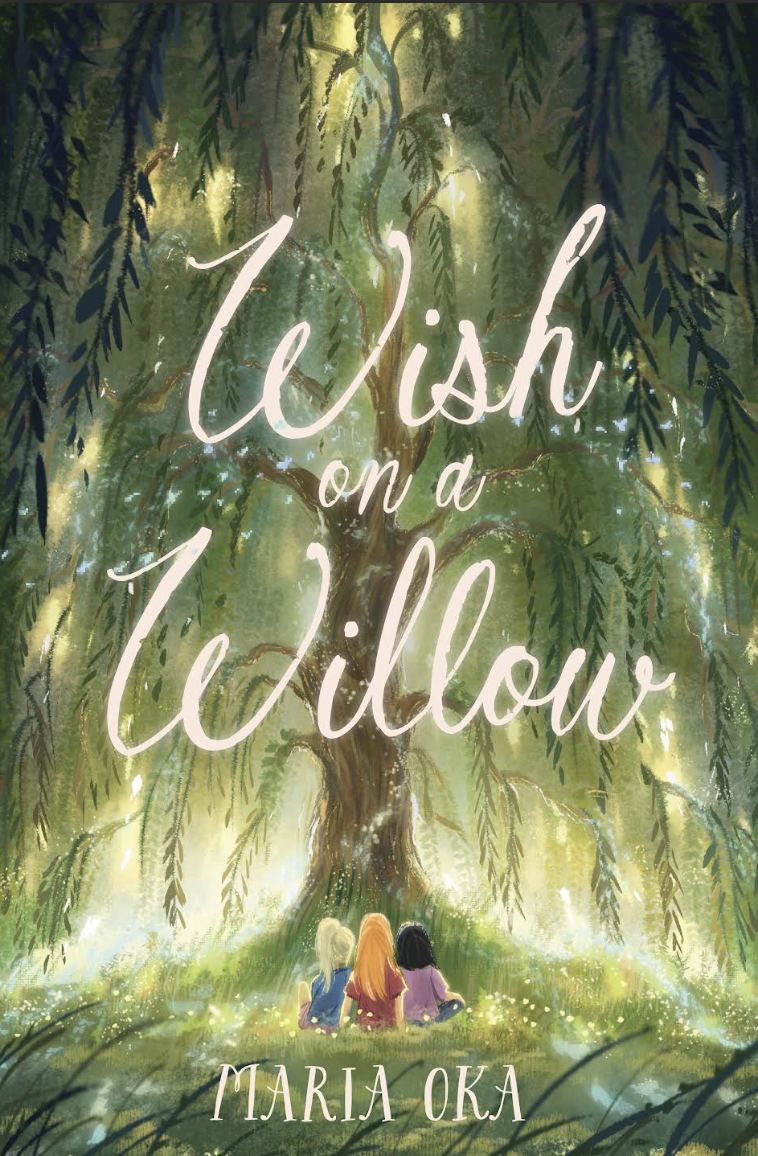
For most of my childhood I lived on two acres in Michigan with lots of trees. Trees were a huge part of the magic of my childhood. I knew I wanted to write a book about a tree that was important to a girl. It took years to find the right character, but one day, Eloise’s voice dropped into my head. Another piece of the inspiration came from my own memories of when I was eleven and living in Brazil. While we were on vacation, my dad fell backwards off a bridge and broke his neck, narrowly avoiding paralysis or death. With this book I was exploring the same questions I’d had at Eloise’s age… “Will my dad be okay? How could I live without him?” When all of those pieces came together (magic trees, Eloise’s voice, and my dad), I had a book!
2. What do you hope young readers take away from this story?
I hope that after reading about Mama Willow, they want to find their own magical, healing places in nature. And I hope they feel that even though life is messy and hard, they are strong, and they will be okay, whatever comes. Lastly, I want them to leave with a strong sense of hope for their own futures.
3. Magic plays an important role in the book. What does “magic” mean to you, and do you think there is magic in everyday life?
I find magic in little moments, in beautiful places, and in people. I absolutely believe there is magic in everyday life. The trick is slowing down enough to find it, and looking in the right places. I find magic in so many spots in nature—a gentle, quiet magic that renews me. I find magic in family and friends, and in the good people do for each other.
4. What makes Eloise unique? What qualities do you think will make her relatable to young readers?
Eloise is both unique and universal. She has gumption and lots of hope, in spite of her difficult circumstances. She also has a believing heart. She certainly isn’t perfect. She has a hard time opening up to her friends and makes some questionable choices – she’s human, but I think both her strengths and weaknesses make her more lovable and more relatable.
5. What type of reader would most enjoy Wish on a Willow?
I hope all types of readers enjoy Wish on a Willow! Technically the book is meant for grades 3-6, and I’m guessing girls in particular may better relate to the journey of these three girls, but I’ve had many boys and older kids, as well as adults, who have loved reading about Eloise and her friends.
6. What makes Wish on a Willow stand out from other middle-grade books?
I hope it stands out in that it has some tough emotions, but tons of hope and wonder at the same time. I’ve been told by a few people that reading it feels like being “wrapped in an embrace.” Gosh, I hope that’s true!
7. Eloise has two close friends. What makes their friendship special, and why was it important to the story?
Eloise felt very alone at the beginning of the book when she was dropped off at her Gee- pa’s by herself. She was in desperate need of some friends. When she met Olive and Kimiko at Mama Willow, it became clear that they needed Eloise as much as she needed them. Their friendship was special because they worked together to help each other and they were there for each other when it mattered most.
8. Why did you choose to weave the father’s journal into the story? What role does family history play in your own life?
When I first started writing, Mama Willow had magic healing power, but there was no journal. But the magic of the tree didn’t feel quite strong enough on its own. I realized the tree needed to be important to Eloise’s dad too in order to become as important as it did to Eloise. That’s where the journal came in. It was when I combined both of those elements, the magic and the memory, that the book really started to click. I think if it had just been a magic tree but with no journal, Eloise would never have found the solution she did to save Mama Willow. Stories, especially our family stories, hold their own magic. I love hearing my family stories—they have informed who I am, and they help me to be braver than I am on my own.
9. How does Gee-pa’s relationship with Eloise evolve throughout the book? Why do you think relationships between children and grandparents are important?
At first Eloise is pretty sure her Gee-pa doesn’t want her around. But eventually she learns that he cares deeply for her—he just shows love differently. I think all family relationships are important. The old learn from the young, and the young learn from the old. Hopefully there is a lot of love and acceptance in those relationships.
10. What was your favorite book when you were eleven years old, and how did it influence you as a reader or writer?
When I was around Eloise’s age, my favorite book was Number the Stars by Lois Lowry. It is such a difficult and yet beautiful story. The prose is spare, but packed with meaning. Though I hadn’t considered the question until now, I think it made me want to read and write books that evoke emotion.
11. What advice would you give to kids who are going through tough times like Eloise?
I would tell them to seek help from the people who love them. Trust them. Let them in. Get out in nature—find places that are healing and go there often. I would also tell them that they are tough, and they are going to be okay.
***
You can purchase Wish on a Willow at Once Upon a Time Bookstore (Maria’s local children’s bookstore) or Amazon.
Maria Oka believes that all trees have magic in them, especially willows. In addition to reading and writing, she loves summer beach days, dance parties, and eating ice cream in any weather. She grew up in Holly, Michigan, and São Paulo, Brazil, as one of seven kids. Maria completed her undergrad at BYU and holds an MFA in writing for children & young adults from VCFA. She lives with her husband and their four daughters in Los Angeles. Wish on a Willow is her first novel.
Find Maria at mariaoka.com and on Instagram @mariaokawriter